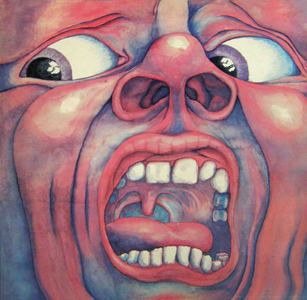
"The pattern juggler lifts his hand, the orchestra begin / As slowly turns the grinding wheel in the court of the crimson king..."
i loved prog rock before i knew what it really was. my mom was an original pink floyd fan, and one of the first songs i have any real memory of listening to was Bohemian Rhapsody, one of my mom's favorite songs ever. without her i probably wouldn't be as into music as i am today: which makes it rather weird that i love king crimson while she's not a huge fan.
In the Court of the Crimson King, which i'm going to shorten to just In the Court, was written in late 1969. this was a time of global turmoil. richard nixon has just been inaugurated for his first term as president and has just overseen the beginnings of operation menu, a tactical bombing campaign in cambodia kept entirely secret from congress and the rest of the united states government. just a year earlier, bobby kennedy had been shot and killed by sirhan sirhan and martin luther king, jr. gets shot and killed just months before the 1968 democratic national convention turns into a warzone. just a few days before In the Court finishes recording in august, charles manson and the family murder sharon tate and 5 other people at her home in california, and the day before recording ends the battle of the bogside begins—the first battle of many in what would later be known as the troubles: a prescient issue for king crimson, a british band. it was not a fun time to be alive.
In the Court was written, recorded, and released smack dab in the middle of all of this. as such, it deals with the subject matter of the 60s—the war in vietnam, increased tensions between the US and USSR, the genocide in biafra, the global feeling of unease and turmoil—in a rather roundabout way. In the Court is a mix of escapism, catharsis, anger, confusion, and pure chaos. there's only 4 songs on the album—8, if you include the bonus tracks—and they all serve very different purposes. 21st Century Schizoid Man lashes out in anger at the world—not from the perspective of the 21st century schizoid man, but rather at him. king crimson ends up lamenting the increasing paranoia and polarization in the world, the continuing violence, genocide, and war crimes being committed in conflict zones across the world, and the global elite being apathetic at their benefit. as poets starve, children bleed, and innocents are raped with napalm fire, the 21st century schizoid man (later identified as none other than vice president spiro agnew, who would later be indicted in 1973 and forced to resign after a tax evasion scandal) couldn't care less. this is all accentuated by a downright nasty instrumental, consisting of heavy guitar riffs alongside a wonderful solo, some of the most intense and intriguing sax playing i've heard in a while, and absolutely phenomenal percussion work.
and then the tone shifts. I Talk to the Wind, Epitaph, and Moonchild are all slower songs, dedicating themselves more to philosophical musings and references to occult writings than political critique. the drums and guitar take a backseat to the woodwinds, primarily the flute and clarinet. I Talk to the Wind in particular laments the chaotic state of everything—if the 21st century schizoid man was apathetic to the chaos and ignoring the violence outside ("Nothing he's got he really needs...") then the character in I Talk to the Wind is more pissed off at everything. he's sick of the fighting, sick of the carnage, sick of the bloodshed. perhaps both of them are the subjects of Epitaph—which laments the uselessness of religion, the power of warfare, and how the fate of the world lies in the hands of those who could care less for it or those who sacrifice themselves for them. the Moonchild, meanwhile, escapes everything in her own little world, and we join her as the song devolves (or evolves?) into a mess of improvized percussion, guitar, and keyboard. this is, incidentally, my least favorite part of the album. i feel like moonchild is a solid 5-6 minutes too long. the improvised instrumentation is cool and is nice, but really wears out its luster after a while. by about 8-9 minutes into the song i just kinda want to get it over with. i skip the last half very very often.
The Court of the Crimson King finally lets it all come full circle. the occult themes, the slower lamentations, and the rockstar energy of 21st Century Schizoid Man all come together in the album's real flagship track. the narrator watches as the court of the crimson king performs their duties just to perform them. the choir sings for the crimson king, the black queen summons the fire witch, the gardener plants, the grinding wheel turns, for no real reason. the crimson king himself is never mentioned. perhaps he doesn't need to be. it's all a show. who is the crimson king? nixon? brezhnev? satan? it doesn't particularly matter. as long as the wheels turn and the court does their duties, the yellow jester will be entertained. as long as the wheels of war continue to turn, as long as the oil and blood and money and influence keep turning, those who rule the world will be happy to sit back and watch as they keep having the benefits flow into their pockets. who cares about the innocents he kills? the crimson king only cares for power, and by god he has it—even if his power is only in the minds of his own court. sure, the yellow jester is pulling the strings, but it's all for the benefit of one man.
i think In the Court is best viewed as a critique of not just the nixon administration but the united states and imperialism as a whole. the cold warrior mentality of the 50s and early 60s had fully degraded by the late 60s. its fighters were either dead, corrupt, or bloodthirsty. JFK and RFK were taken by assassins. nixon was authorizing illegal bombing campaigns and conducting chemical warfare in vietnam. johnson started the vietnam war and left the office in shame, his reputation in tatters. just four years later, nixon would resign in the wake of the watergate scandal. the themes present in In the Court are still omnipresent in the world around us with the invasions of iraq and afghanistan, obama's drone warfare campaigns in the middle east, bush's hand in the rise of ISIL, and trump's intervention in venezuela.
the grinding wheel continues to turn.